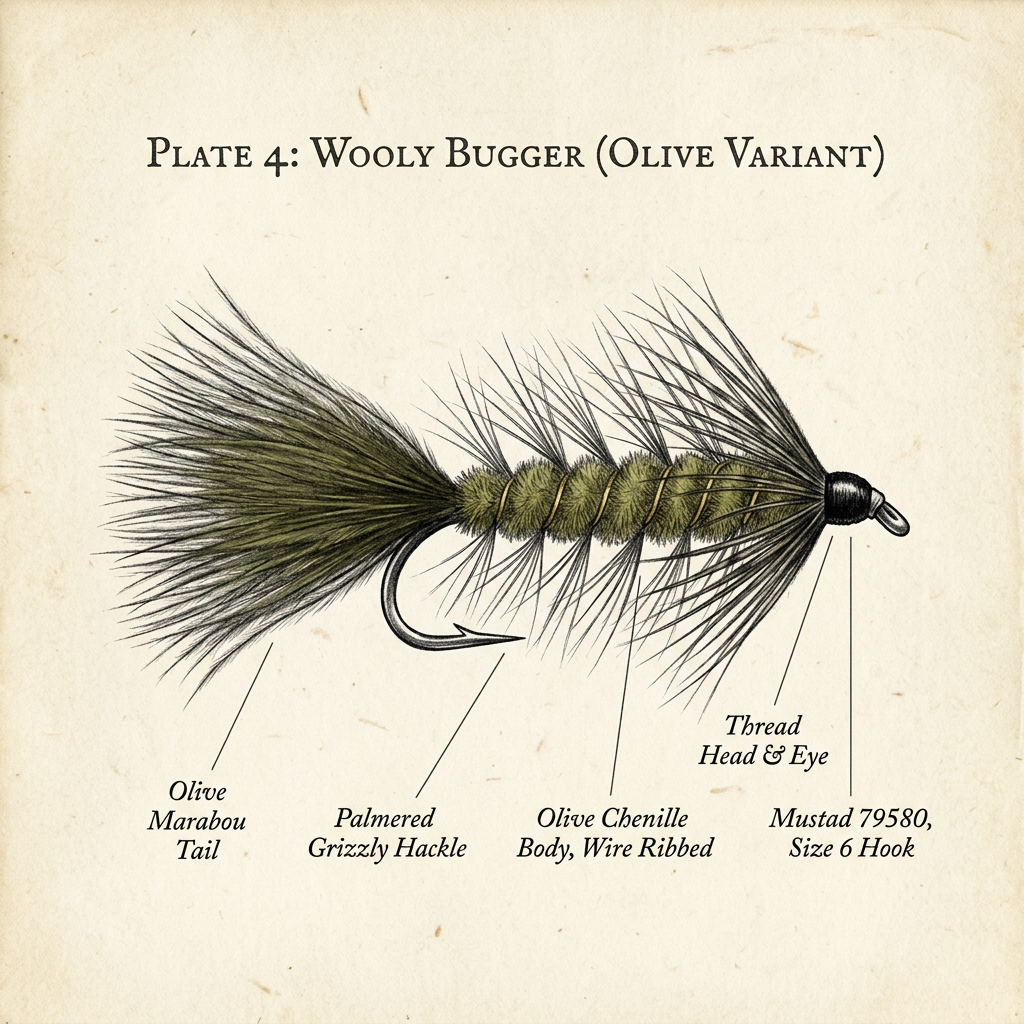
Plate 4: Woolly Bugger (Olive Variant) — olive marabou tail, wire-ribbed chenille body, palmered grizzly hackle. Mustad 79580, size 6.
The most versatile fly in Colorado. Imitates leeches, crayfish, sculpins, and baitfish. If you could only fish one pattern, this is it.
Plate 4: Woolly Bugger (Olive Variant) — olive marabou tail, wire-ribbed chenille body, palmered grizzly hackle. Mustad 79580, size 6.
The Woolly Bugger works on every river The Peak covers, every month of the year. It's the fly you tie on when nothing else is working, when the water is off-color, or when you want to cover water fast and find aggressive fish.
In Colorado's high-country rivers, the Woolly Bugger imitates several food sources depending on how you fish it: stripped fast, it mimics a fleeing sculpin or baitfish. Dead-drifted near the bottom, it becomes a leech or stonefly nymph. Swung through a tailout, it looks like a crayfish tumbling in the current.
It's particularly deadly in these conditions:
Place the hook in your vise with the point down. Wrap 15–20 turns of lead wire around the hook shank, starting behind the eye and stopping above the barb. Push the wraps to the center of the shank. Start your thread behind the eye and build thread ramps on either side of the lead wraps to lock them in place.
Wrap your thread back to the bend of the hook. Select a marabou feather with full, fluffy fibers and measure it to one hook-shank length. Tie it in at the bend, keeping the marabou on top of the shank. Make several tight wraps to secure. The tail is the fly's primary action — don't trim it short.
Select a saddle hackle feather with barbs roughly 1.5 times the hook gap in length. Strip the fluffy base fibers to expose the stem. Tie in the hackle by the tip at the base of the tail, shiny side facing you. This orientation ensures the hackle fibers sweep back when palmered forward.
Strip about 1/4" of chenille fibers to expose the thread core. Tie in the exposed core at the base of the tail, right where you tied in the hackle. Now advance your thread forward in smooth wraps to two eye-lengths behind the hook eye. Leave room for a clean head.
Wrap the chenille forward in tight, touching turns. Keep each wrap snug against the previous one to create a full, even body. Stop two eye-lengths behind the hook eye. Tie off with 3–4 tight thread wraps and trim the excess chenille.
Grip the hackle stem with hackle pliers. Wrap the hackle forward in evenly spaced spiral turns through the chenille body — about 5–6 turns for a size 8 hook. Keep even spacing so the hackle fibers radiate uniformly. Tie off behind the eye with several tight wraps and trim the excess hackle.
Build a small, neat thread head to cover all tie-off points. Whip finish with 3–4 turns and cut the thread. Apply a drop of head cement or UV resin to the thread head for durability. Let it dry before fishing.
Size 8 is the best all-around choice for most Colorado rivers. Go larger (size 6) on bigger water like the Colorado River or during spring runoff. Go smaller (size 10–12) on technical tailwaters like the Blue River below Dillon Dam or the South Platte Dream Stream where fish see more pressure.
Olive and black are the two essential colors. Olive imitates leeches and crayfish common in most Front Range and mountain rivers. Black works best in off-color water and during overcast days. Carry both.
Cast upstream and across, let the fly sink near the bottom, and retrieve with short, erratic strips. In deeper pools, add a sinking tip or weight. The key in Colorado's clear, high-altitude water is to strip slowly — trout often follow before committing.
Gold Medal tailwater below Dillon Dam. Technical nymphing for large browns.
Trophy water between Spinney and Eleven Mile reservoirs.
Freestone river through Eagle County. Great dry fly water in summer.
Urban trout fishery running through Vail. Pocket water and riffles.
Live scores, hatch updates, and which patterns are working right now. Free every Thursday morning.