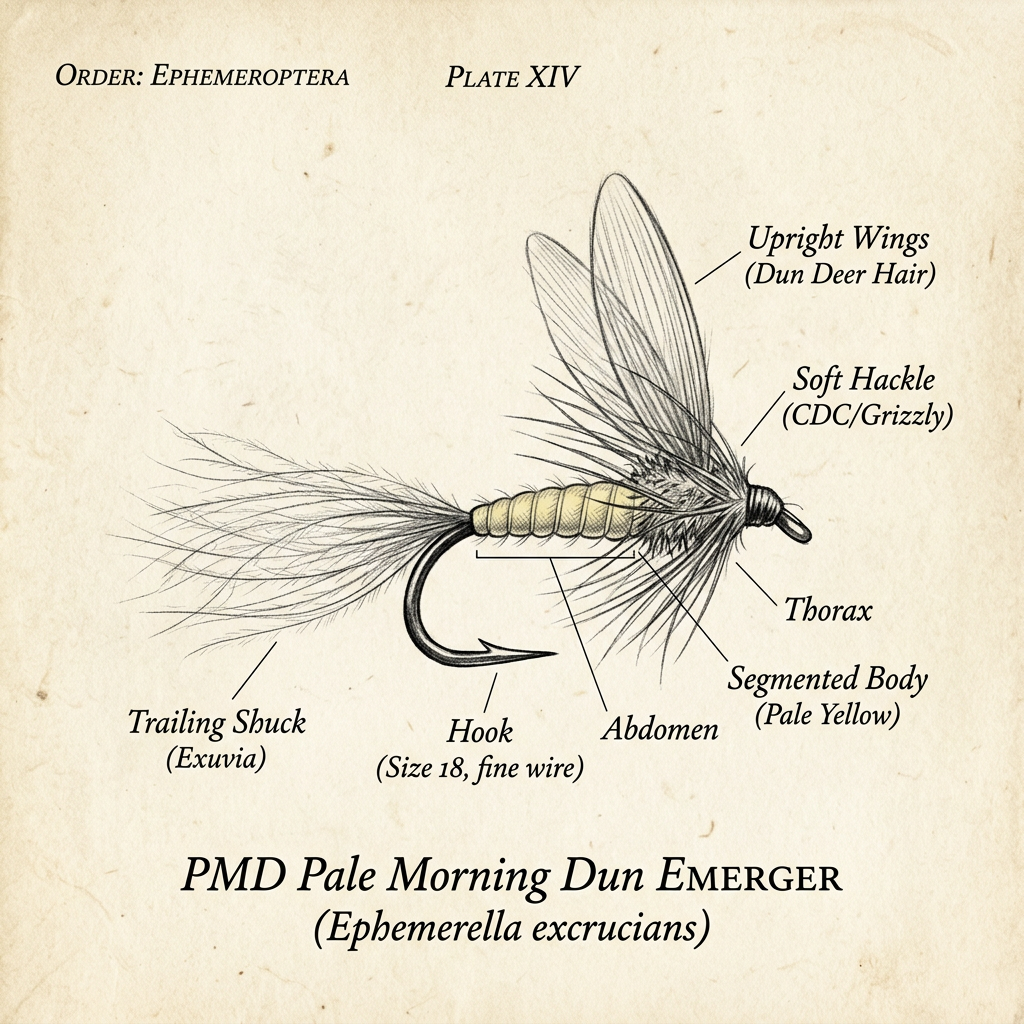
Plate II: PMD Emerger (Ephemerella excrucians) — pheasant tail trailing shuck, pale yellow dubbed abdomen, CDC wing bud. Size 16 emerger hook.
The Pale Morning Dun is Colorado's most important summer mayfly. This emerger pattern catches fish when they're keyed in on the vulnerable transition from nymph to adult — which is most of the time.
Plate II: PMD Emerger (Ephemerella excrucians) — pheasant tail trailing shuck, pale yellow dubbed abdomen, CDC wing bud. Size 16 emerger hook.
Pale Morning Duns (Ephemerella excrucians) are among the most prolific mayflies on Colorado's tailwaters and spring creeks. The hatch runs from late June through August, with peak activity in July. When PMDs are coming off, trout feed with a rhythmic, confident rise form — and they're usually eating emergers, not duns.
The emerger stage is when the nymph sheds its shuck at the surface and the adult unfolds its wings. Trout know this is the easiest meal. A PMD emerger fished in or just below the surface film will outfish a standard dry fly during most PMD hatches on Colorado water.
Fish this pattern when:
Place the hook in your vise. Start your thread behind the eye and wrap back to the bend. Select 4–6 pheasant tail fibers and tie them in at the bend, extending about half a shank length past the hook. The trailing shuck imitates the nymphal exoskeleton the emerging mayfly is shedding — it's the key feature of this pattern.
Tie in a 3-inch piece of fine gold wire at the bend, alongside the trailing shuck. The wire will reinforce the abdomen and add subtle segmentation that catches light underwater.
Apply a thin, tight layer of pale yellow dubbing to your thread. Wrap forward to the midpoint of the shank in smooth, touching turns. The abdomen should be slim and slightly tapered — thinner at the tail, slightly thicker toward the middle. PMDs have delicate bodies; resist the urge to overdub.
Wrap the gold wire forward in 4–5 evenly spaced spiral turns through the dubbed abdomen. Tie off behind the midpoint with several tight thread wraps and helicopter the excess to break it cleanly.
Apply slightly more dubbing to your thread than you used for the abdomen. Wrap a fuller thorax from the midpoint to just behind the eye. The thorax should be noticeably thicker than the abdomen — this profile mimics the bulging wing case of the emerging dun. Leave room behind the eye for the wing and head.
Select a light dun CDC feather with full, buoyant fibers. Tie it in by the butt on top of the thorax so the feather tips extend back over the body, reaching roughly to the bend. CDC traps air bubbles and sits in the surface film perfectly — don't substitute synthetic materials. Trim the butt end, build a small thread head, whip finish, and apply a tiny drop of head cement to the thread only (keep cement off the CDC).
Pale Morning Duns hatch from late June through August, with peak activity in July. Hatches typically occur mid-morning to early afternoon, especially on overcast days. The Blue River, Dream Stream, and Cheesman Canyon all have strong PMD hatches.
Size 16 is the standard for most Colorado PMD hatches. On heavily pressured tailwaters like the Blue River or Cheesman Canyon, go down to a size 18. Match what you see on the water — early season PMDs tend to be slightly larger.
During a PMD hatch, trout often feed on emerging nymphs just below or in the surface film rather than fully hatched adults on top. An emerger fished in the film imitates this vulnerable stage and often outperforms a standard dry fly, especially on technical water like Cheesman Canyon.
Gold Medal tailwater below Dillon Dam. Strong PMD hatches in July.
Trophy water between Spinney and Eleven Mile reservoirs.
Technical catch-and-release canyon. Best PMD water in Colorado.
Freestone river through Eagle County. Great dry fly water in summer.
Live scores, hatch updates, and which patterns are working right now. Free every Thursday morning.